
How Burke County Court Records Follow an Arrest
After a Burke County arrest, the custody record and the court record usually begin in different places. The custody side is created when the person is booked at Burke County Jail, also called the Burke County Detention Center, at 225 Highway 24 South in Waynesboro. The roster can show the person's name, status, arrest date, arresting agency, warrant number, statute, charge description, misdemeanor or felony marker, court, days in jail, and total bond. Those fields are useful for identifying the case, but they are not the final court record.
The court side is handled through the Burke County Clerk of Superior, State, and Juvenile Court and the courts that receive the case. The clerk's local page places the office at the Burke County Judicial Center, 200 East 6th Street, P.O. Box 80, Waynesboro, Georgia 30830. The GSCCCA clerk listing gives Clerk Radeta G. Smith, phone 706-554-2279, fax 706-554-7887, and hours of 8:30 AM to 5:00 PM Monday through Friday. Burke court records after an arrest may include filed accusations, indictments, hearings, docket proceedings, dispositions, and documents, depending on the court and access limits.
The Augusta Judicial Circuit District Attorney's Office is the prosecutor's office for felony matters in Burke and Richmond Counties. Its Waynesboro office is listed at 200 East Sixth Street, Waynesboro, Georgia 30830, phone 762-225-6524. The DA's office represents the people of Georgia in felony cases and may handle matters from initial arrest through appeals. That prosecutor role is why a booking charge can be different from the charge that appears later in Superior Court.
For custody, bond, and booking details, use Burke County jail inmate records. For booking-photo questions, use Burke County jail mugshots. Court records after a jail arrest focus on the formal criminal case, not just the fact that someone was arrested or photographed.
How to Find Court Records After a Burke County Arrest
Start with the official jail roster only long enough to capture identifiers. The sheriff's inmate inquiry page links to the InteropWeb Burke jail population portal, where the Current Inmates, 24 Hours Arrests, and Inmates by Arrest Date tabs may show the arrest date, agency, warrant number, statute, court, and charge description. Those details help narrow the court search, especially when a name is common or the case has not yet reached a final disposition.
- Open the sheriff inmate inquiry page at burkecountysheriff.com/inmate-inquiry.cfm, accept the disclaimer, and use the roster tabs to record the exact name, arrest date, warrant number, statute, and listed court.
- Check whether the charge appears to belong in Superior Court, State Court, Magistrate Court, or Municipal Court. Felony rows generally point toward Superior Court, while misdemeanor and traffic matters may appear in State Court or Municipal Court. Magistrate Court is important for warrants, first appearance, and preliminary functions.
- Use the Georgia Courts e-access page and PeachCourt when account access is available. Georgia Courts lists Burke State and Burke Superior as e-access courts that route to PeachCourt.
- Search by party name or case number, then review the charge list, docket events, case status, calendar events, dispositions, and available documents.
- If online access fails or the case is too new, call the Burke Clerk at 706-554-2279 or visit the Judicial Center during posted business hours.
The Georgia Courts e-access page explains that users are redirected to provider websites for court-record access.
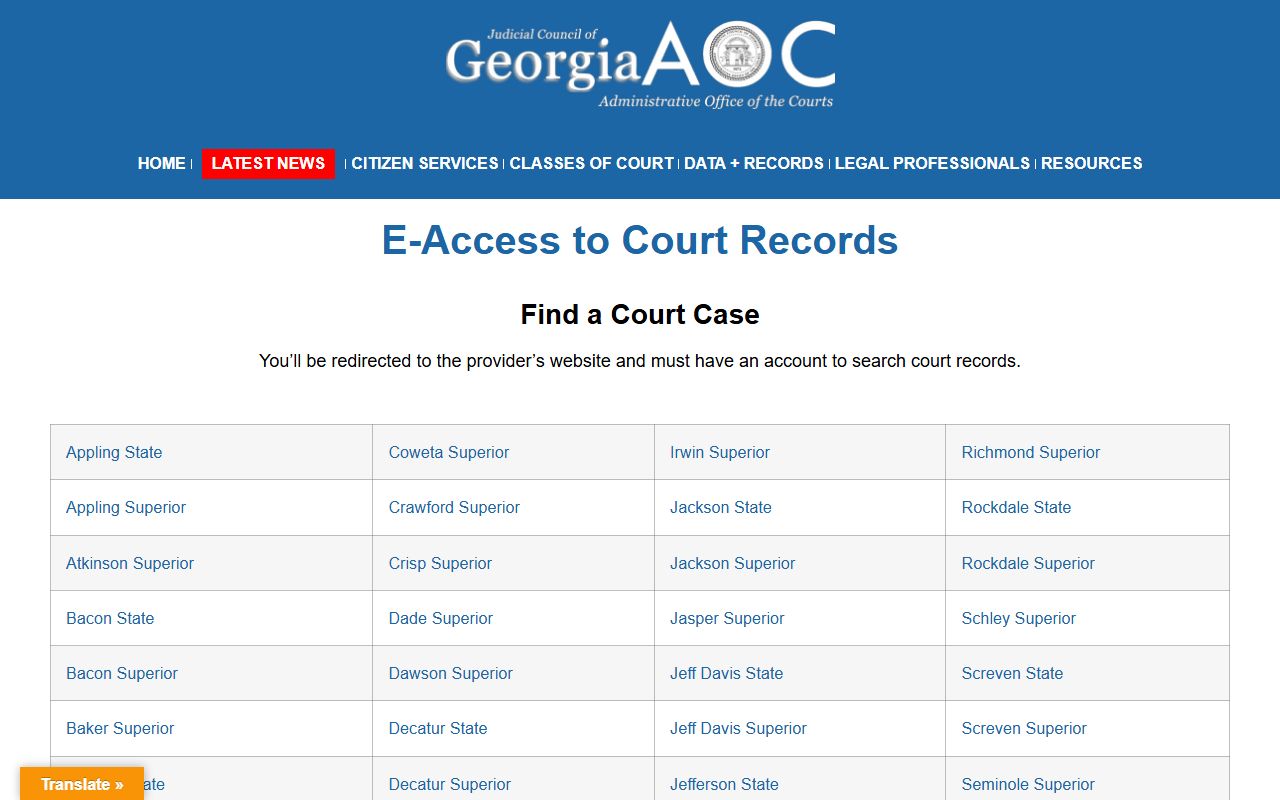
For Burke court records after an arrest, that routing detail matters because the state page does not itself hold every docket. It points users to the provider used by the local court.
PeachCourt is the provider identified for Burke State and Burke Superior access.

PeachCourt help says users can select a county and court, then search by case number or party name. Criminal dockets may show assigned judge, case status, co-defendants, prosecuting attorney, defense attorney, charges, disposition date, calendar events, docket proceedings, and case documents, depending on court availability.
PeachCourt Account Fields for Court Records After Arrest
PeachCourt requires registration or login for case search. The account registration screen uses the following fields. These are account fields, not proof that a specific Burke criminal case exists.
| Field | Required | Notes |
|---|---|---|
| Last Name and First Name | Yes | Used for account registration. |
| Email Address and Confirm Email Address | Yes | Both entries must match. |
| Password and Confirm Password | Yes | Used for login credentials. |
| Secret Question and Secret Answer | Yes | Used for account recovery. |
| 4-digit PIN | Yes | Account security field. |
| reCAPTCHA and Terms checkbox | Yes | Verification and user agreement. |
PeachCourt document help also notes that file-stamped documents from many State and Superior Courts may be available, while sealed matters, adoption files, and unexecuted proposed orders are not expected to appear. Many dockets go back to about 2005. Document cost is listed as $0.50 per page plus a convenience fee, so a court-record search can have a cost even when the jail roster is free.
Charging Documents in Court Records After an Arrest
Booking starts the jail record, but a charging document starts or advances the formal court case. In Burke County, the arrest may first appear on the jail roster with a statute and charge description. The prosecutor, court, or grand jury process can then produce a complaint, accusation, information, or indictment. The exact document depends on the charge level, court, and case stage.
| Document | Who Uses It | What It Does | Burke County Search Note |
|---|---|---|---|
| Complaint or warrant application | Officer, complainant, or Magistrate Court process | Supports arrest, warrant, or first court handling. | The roster may show a Warrant# column after booking. |
| Accusation or information | Prosecutor | States the charges the prosecutor files without using an indictment for that filing path. | Look for prosecuting attorney, charge, disposition, and docket entries. |
| Indictment | Grand jury process | Charges serious felony matters after grand jury review. | Felony matters are generally connected to Superior Court. |
| Amended filing | Prosecutor or court process | Changes, reduces, or replaces earlier charge language. | Compare the court charge list against the original jail roster charge. |
Charge Status in Court Records After a Jail Arrest
Charge status can change after an arrest. A jail roster entry may show what the person was booked on, while the court record may show what was actually filed, what was dismissed, what was amended, and what ended in a plea or verdict. For that reason, never treat a booking charge as a conviction.
| Status | What It Means | Why It Matters |
|---|---|---|
| Pending | The charge has not reached final disposition. | The person may still have upcoming hearings, bond conditions, discovery, or plea negotiations. |
| Amended or reduced | The filed charge changed from the original booking or earlier court entry. | The final court record may not match the arrest wording on the roster. |
| Dismissed | The charge was ended by court order or prosecution action. | A dismissal is not the same as a conviction and may affect record-restriction eligibility. |
| Nolle prosequi | The prosecutor declined to continue that charge. | The docket may still show the filing history even when prosecution does not proceed. |
| Convicted or guilty plea | The charge resulted in a conviction by plea or verdict. | Sentencing and possible transfer to GDC custody may follow if state prison time is imposed. |
Bond and First Appearance After an Arrest
The Burke roster lists Total Bond at the main roster-entry level. Observed values included dollar amounts, DENIED, and NOT SET. Inspected charge rows did not show separate per-charge bond amounts. Georgia Uniform Magistrate Court Rule 25.1 says first appearance must occur immediately after arrest and no later than 48 hours after a warrantless arrest or 72 hours after arrest with a warrant unless bond has already been made.
No Burke-specific official page was found that publishes exact bond-posting hours, accepted payment methods, a bond schedule, property-bond rules, or bondsman procedures. Call the Burke County Sheriff's Office or jail at 706-554-2133 before attempting to post bond. If another agency has a detainer or hold, a listed dollar bond may not be enough to cause release.
| Bond Type | How It Works |
|---|---|
| Cash bond | Money or security is posted for release, subject to the court's rules and later case handling. |
| Surety bond | A licensed bonding company posts the bond, usually under a private agreement with the person arranging release. |
| Property bond | Qualifying property may be used if accepted and verified through the proper court or jail process. |
| Personal recognizance | Release is based on the promise to appear, without a cash bond. |
| No bond or denied bond | No release is allowed at that stage, or bond has not yet been set by the judicial officer. |
Warrants, Arrest Records, and Court Routing
No official Burke County active-warrant public search portal was located. After an arrest, however, the Burke jail roster may show a Warrant# column in the charge table. Georgia Courts states that State Courts may issue search and arrest warrants and hold preliminary hearings, while Magistrate Courts issue warrants and handle minor criminal matters. Uniform Magistrate Court Rule 24.2 says that once an arrest is made, the original warrant is returned to the magistrate court or designee for transfer to the appropriate prosecuting agency.
For warrant-related court records after an arrest, use the roster to identify the warrant number, then contact the Burke Clerk or the appropriate court. For custody confirmation, call the sheriff or jail at 706-554-2133. For law-enforcement records that are not online, use the sheriff's open-records request process, subject to Georgia exemptions and pending-case limits.
Charges vs. Convictions in Court Records After Arrest
An arrest charge is an accusation tied to booking or case filing. A conviction is a final outcome after a guilty plea, verdict, or other qualifying disposition. Georgia court records can show both, but the meanings are different. This distinction is especially important when a Burke roster entry shows a felony or misdemeanor charge before the prosecutor has made final filing decisions.
| Charge | Conviction | |
|---|---|---|
| Stage | Appears after arrest, warrant, accusation, information, or indictment. | Appears after plea, verdict, or final adjudication. |
| Meaning | An allegation that must still be handled in court. | A court outcome that can support sentencing and collateral consequences. |
| Proof level | May begin from probable cause or prosecutor filing. | Requires proof beyond a reasonable doubt or a knowing guilty plea. |
| Record note | May be amended, reduced, dismissed, or not prosecuted. | May later be appealed, modified, or subject to certain post-conviction processes. |
Sealed vs. Expunged Arrest and Court Records
Georgia commonly uses the term record restriction rather than expungement. The GBI record-restriction guidance cites O.C.G.A. 35-3-37 and explains that eligible criminal-history records may be restricted for non-criminal-justice purposes after agency, prosecutor, or court approval. A restricted Georgia record is not the same as a physically destroyed record.
| Restricted or Sealed | Expunged | |
|---|---|---|
| Georgia terminology | Record restriction is the main Georgia process for limiting public criminal-history access. | Often used casually, but Georgia guidance usually describes restriction instead. |
| Public visibility | Hidden or limited for non-criminal-justice purposes when approved. | Commonly understood as removed or treated as unavailable, but Georgia eligibility follows state restriction law. |
| Who may still see it | Criminal-justice agencies may retain access in ways the general public does not. | Access depends on the actual order and law, not the label used by a requester. |
| Common trigger | Dismissal, no prosecution, acquittal, or other eligible disposition may support a request. | Do not assume automatic removal from every court, jail, or private database. |
Public Access Limits for Court Records After Arrest
Georgia's Open Records Act, O.C.G.A. 50-18-70 et seq., generally opens public records for inspection and copying unless a law or court order exempts them. State guidance says the public-record definition includes documents, photographs, computer-generated information, data, and data fields. O.C.G.A. 50-18-71 addresses responses and fees; agencies generally respond within three business days and may charge reasonable search, retrieval, redaction, and copying costs.
The Burke sheriff open-records page lists inmate records and photos among requestable record types, but it also warns that pending criminal-case information may require contact with the clerk, court, and discovery procedures. Juvenile records, sealed files, restricted records, unexecuted proposed orders, protected victim information, and active investigative material may be unavailable through ordinary public search.
Important: Custody and court lookup information is not a consumer report under the Fair Credit Reporting Act and cannot be used for employment, credit, housing, insurance, or other FCRA-covered decisions.
District Attorney Role in Court Records After a Jail Arrest
The Augusta Judicial Circuit District Attorney's Office page identifies the office that prosecutes felony matters for Burke and Richmond Counties.
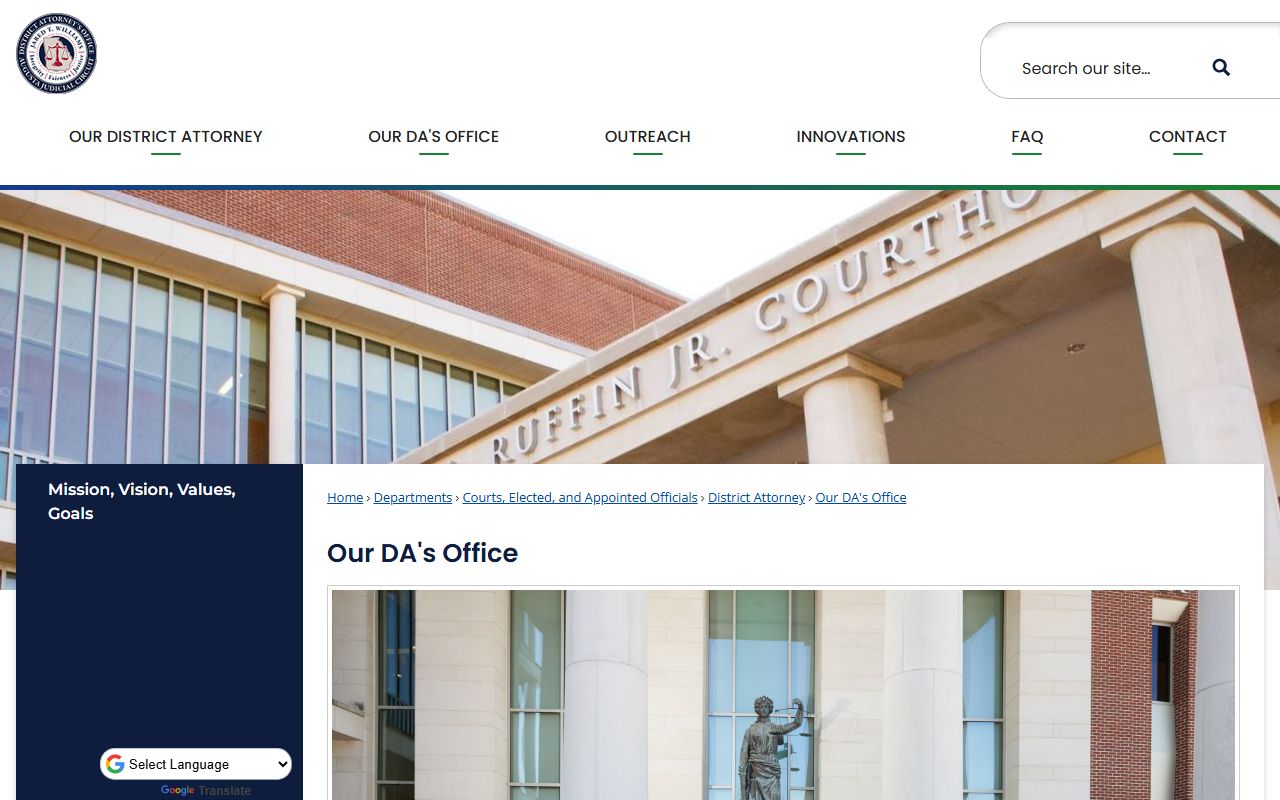
The DA page and related office material explain why the court record can evolve after booking: assistant district attorneys handle felony cases, victim advocates support case updates, investigators secure evidence and serve subpoenas, and the office has a full-time Burke County presence. Those prosecutor decisions are part of the court record after arrest, not the jail roster itself.